

Jing Pan
Updated Aug 20, 2025
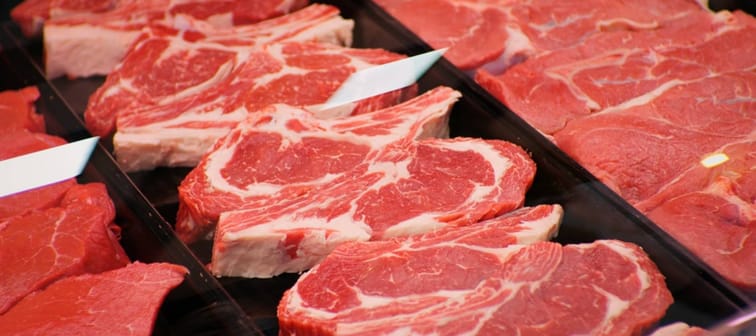
Beef prices are climbing in the U.S. — and the latest government data confirms it. According to the Consumer Price Index from the Bureau of Labor Statistics, U.S. beef and veal prices have jumped 8.6% over the past year. Ground beef surged to US$6.34 per pound in July, up from US$2.50 per pound just a year earlier. Steak prices were also up 10.6% in the same time period.
However, it's not only our neighbours south of the border who are feeling the sting. In Canadian grocery stores, the cost of ground beef rose 25% between May of this year and last year — well above the current inflation rate, the CBC reports.
The pressure on the U.S. market is due to supply, Omaha Steaks President and CEO Nate Rempe says.
“The number of head of cattle in the United States is at a low, really not seen since the 1950s. In fact, it's wild,” Rempe recently told Fox Business.
As of Jan. 1, 2025, there were 86.7 million heads of cattle and calves on U.S. farms, according to the Department of Agriculture — the lowest count since 1951.
While this shortfall is understandably driving the increase in prices south of the border, what’s to blame for the climbing prices in Canada? Below, we’ll break down how the two markets are interconnected — and how this issue affects investors in food and agriculture.
Rising food costs
With beef demand still strong in the U.S., Rempe warned that tight supply is “putting a lot of upward pressure” on prices — and it won’t be resolved overnight.
“Supply is a tricky issue. You can't just flip a switch [or] adjust a tariff. We need to rebuild the herd, and that's going to happen over the next roughly 12 months. My guess is by Q3 [20]26 we'll kind of start to come out of this,” he said in the interview with Fox.
Beef isn’t the only grocery item getting more expensive in the states. The food index from the CPI has surged 26% over the past five years, and the USDA expects food prices to rise another 2.9% in 2025.
Correspondingly, the cost of food in Canada rose 2.9% year-over-year in June 2025. With our markets so closely intertwined, the cost of essentials like food and housing remains persistently high across North America.
Cattle production in particular is intermingled. While the U.S. produced 19.72% of the world’s beef in 2024, demand for red meat is still higher than what the country supplies domestically. America remains our largest export market, with a share of 75.2% of beef exports as of 2023. In kind, we import our largest share of beef from the U.S. — 1,362,306 tonnes, as of 2024.

Sponsored
Smart investing starts here
Build your own investment portfolio with CIBC Investor’s Edge online and mobile trading platform. Enjoy low commissions on trades and special pricing for active traders, students and young investors.
Get started todayThe impact of rising prices on investors
Tariffs have rocked the agriculture industry as much as the rest of the country, causing Canadian farmers to cull their herds and brace for fewer exports as Trump’s plan unfolds. A report from Dalhousie University suggests that Canadians would do well to invest in our own agricultural innovation to weather the shock of tariffs, which will boost productivity and enhance our global competitiveness.
The Alberta Beef Producers association reported that the industry is “actively exploring” other export markets outside the U.S., with a market diversification strategy to expand to other high opportunity export markets. As tariffs on beef imports impact many other U.S. trade partners, Canadian suppliers may be able to swoop in and make mutually-beneficial trade deals with those countries. Representatives from the Canada Beef association have travelled to seven different countries as of the end of June to raise awareness and open negotiations.
The industry is also investing heavily in domestic marketing to take advantage of the ‘elbows up’ consumer sentiment that has seen more Canadians choosing domestic products when they shop.
In spite of these efforts, tariff uncertainty and the tight integration of the U.S. and Canadian cattle and beef markets will likely continue to produce strong effects on pricing in the months to come.
Will Lowe, Chair of the National Cattle Feeders’ Association, said in February, “The impact of this tariff on cattle producers will be felt immediately and severely. The cattle sector is a highly integrated North American market. When dealing with live animals, you are not able to pivot quickly, and this tariff could cripple the world-renowned beef industry on both sides of the border.”
Time will tell if the combined investment in new markets and strengthening domestic demand sees the industry weathering the impact of Trump’s tariffs on Canadian cattle farmers.
with files from Rebecca Holland
Sources
1. U.S. Bureau of Labour Statistics: Average price data (in U.S. dollars), selected items
2. U.S. Bureau of Labour Statistics: Average Retail Food and Energy Prices, U.S. and Midwest Region
3. Statistics Canada: Monthly average retail prices for selected products (Aug 6, 2025)
4. CBC: Beef costs more than ever, but Canadians won't let that ruin barbecue season, by Colin Butler (Aug 3, 2025)
5. Trading Economics: Canada Food Inflation
6. Iowa State University: US and Canada both benefit from two-way cattle trade, by Lee Schulz (Mar 2025)
7. Canadian Beef: Canada's Beef Industry: Fast Facts (Jun 2024)
8. Government of Canada: Supply comparison by species between Canada and the United States (Jun 27, 2025)
9. Yahoo: Analysis-Beef prices may rise as Canadian ranchers shrink cattle herds, fearing Trump tariffs, by Ed White (Feb 28, 2025)
10. Dalhousie University: Resilient, sustainable food systems are Canada’s best defence against American tariffs, by Érick Duchesne, Gregory Cameron, Gumataw Kifle Abebe and Monika Korzun (Jun 26, 2025)
11. ABP Daily: Canada Beef adopts new market diversification strategy amid trade challenges, by Canada Beef (Jun 25, 2025)
How Dave Ramsey’s plan helps people ditch debt for good
Tired of living paycheck to paycheck? Dave Ramsey’s popular 7-step method shows you exactly how to wipe out debt and finally build real savings. No gimmicks — just a clear plan that works.

Jing Pan
Investment Reporter
Jing is an investment reporter for Money.ca. Prior to joining the team, Jing was a research analyst and editor at one of the leading financial publishing companies in North America. Jing has covered numerous aspects of the financial markets, from blue chip dividend stocks to small cap tech stocks to precious metals and currency. An avid advocate of investing for passive income, he wrote a monthly dividend stock newsletter for the better half of the past decade. In his spare time, Jing plays basketball, the violin and the ukulele.
Explore the latest articles

Is it time to swap your travel rewards credit card for cash-back?
With your travel plans up in the air, it may be time for a new credit card.

Barry Choi
Contributor


Disclaimer
The content provided on Money.ca is information to help users become financially literate. It is neither tax nor legal advice, is not intended to be relied upon as a forecast, research or investment advice, and is not a recommendation, offer or solicitation to buy or sell any securities or to adopt any investment strategy. Tax, investment and all other decisions should be made, as appropriate, only with guidance from a qualified professional. We make no representation or warranty of any kind, either express or implied, with respect to the data provided, the timeliness thereof, the results to be obtained by the use thereof or any other matter. Advertisers are not responsible for the content of this site, including any editorials or reviews that may appear on this site. For complete and current information on any advertiser product, please visit their website.
†Terms and Conditions apply.
