

Hannah Logan
Updated Aug 19, 2025
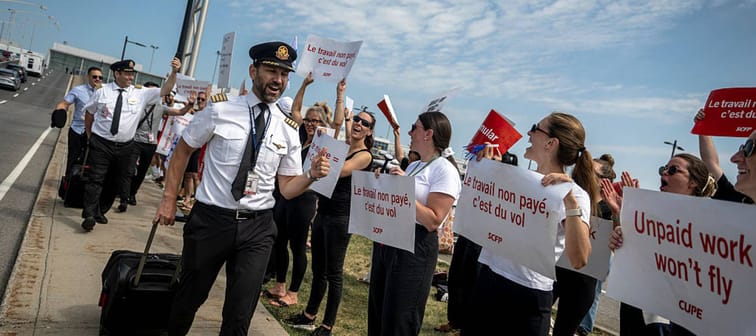
Flight cancellations remain one of the biggest frustrations for Canadian travellers — especially now. As of mid-August 2025, about 10,000 Air Canada flight attendants, represented by the Canadian Union of Public Employees (CUPE), launched a strike over failed negotiations on wages and unpaid “groundwork” duties such as boarding and deplaning. The disruption has triggered widespread chaos during the peak summer travel season, stranding roughly 130,000 passengers per day, according to multiple reports.
Despite the Canada Industrial Relations Board (CIRB) declaring the strike illegal and issuing a binding arbitration order, CUPE has vowed to defy the ruling. Union leaders remain on the picket lines, even expressing readiness to face jail time to fight for their demands.
In response, Air Canada has suspended its 2025 financial forecasts and cancelled hundreds of flights, with disruptions expected to continue for the foreseeable future. As a result, Air Canada is urging customers not to go to the airport unless they have confirmed alternative travel arrangements.
For those stuck unable to travel — or those forced to make alternative arrangements — the question remains: What happens when a flight gets cancelled in Canada?
You're protected when flights get cancelled
Flight cancellations remain one of the biggest frustrations for Canadian travellers. In 2023 alone, airlines ranked among the top five most complained-about industries to the Canadian Transportation Agency (CTA), with more than 57,000 complaints filed — a record high according to a CTA report. While some of these relate to delays, baggage, and accessibility, flight cancellations continue to make up a significant share.
Given the prevalence of these issues, Canadian travellers should become familiar with the Air Passenger Protection Regulations (APPR), which were developed by the Canadian Transportation Agency (CTA) and came into effect in 2019. The APPR covers flights to, from, and within Canada, including connecting flights.
Know your (updated) rights
Original rules
Originally, when the CTA (and the APPR) created rules to protect travellers, the airlines only had to compensate passengers who experienced flight disruptions if the problem was “within the carrier’s control.” But over the years many airlines experienced crew shortages, which then resulted in cancelled and delayed flights. Airlines claimed this labour shortage was beyond their control, leaving passengers stuck and without any compensation. This situation occurred so often that the CTA had to amend its rules.
Amended rules 2022
As of September 2022, new regulations went into force relating to flight delays and cancellations outside of airline control. This includes factors such as weather, political instability, medical emergencies and more. According to these new regulations any flight delayed for three hours or more — or cancelled — requires the airline to provide affected passengers with a confirmed reservation on the next available flight. The flight can be offered by the same airline — or a partnered one — and must be within 48 hours of the original departure time. If the airline can’t accommodate passengers based on these parameters, they are required to either provide a refund or make alternative arrangements for the passenger free of charge. For large airlines, this means rebooking the traveller on the next available flight on any airline, including competitors.
However, if the issue is outside of the airline’s control — like bad weather — the airline is not required to provide coverage for any additional costs such as food or lodging.
Furthermore, all refunds under the APPR must be received within 30 days and any vouchers or credits (which may be offered as an alternative to a refund) must not expire.
Amended rules 2023
In 2023, the CTA announced stricter enforcement rules, requiring airlines to automatically issue refunds within 30 days if alternative travel can’t be arranged, regardless of whether the disruption is within or outside airline control.
Airlines are still required to rebook affected passengers free of charge — even rebooking the traveller on with a competitor airline.
The compensation for delays or cancellations also increased with large airlines now required to reimburse between $400 and $1,000, depending on the length of time of the delay; small airlines are required to compensate betwen $125 and $500.

Sponsored
Smart investing starts here
Build your own investment portfolio with CIBC Investor’s Edge online and mobile trading platform. Enjoy low commissions on trades and special pricing for active traders, students and young investors.
Get started todayHow to file a complaint
Situations where you may be eligible for filing a complaint include:
- Flight delays and cancellations
- Lost luggage
- Lack of accessible transportation for disabled or elderly
- Discrimination on the basis of race/religion/gender expression etc.
Should you be in a position where you need to request compensation or a refund from an airline, the first step is to go directly to the airline. If the airline denies your claim, you can then file a complaint with the CTA. These claims require a lot of paperwork so make sure to keep all documents related to your flight and your correspondence with the airline. This includes the original flight details (flight number, airline, date and time), and any official notification that your flight has been changed.
It’s also handy to hold onto any receipts from food or accommodation that you needed to purchase as a result of the cancelled or delayed flight.
Under the APPR rules, you have up to one year to make a claim (in writing) against the airline and the airline then has 30 days to respond by either issuing payment or explaining why compensation is not owed.
Be prepared for a long wait
As of 2023, the CTA has a backlog of over 60,000 complaints, and wait times can be 18 months or longer.
As a result, travellers should consider other methods of obtaining compensation. For instance, travellers who book travel using a premium travel credit card should start a compensation claim with their credit card issuer. Another option is to file a legal claim with small claims court. You don't need a lawyer for small claims court, but you will need to pay a nominal application fee and confirm that the sought-after compensation is less than the stated threshold. The threshold will depend on where you live in Canada but is typically $25,000 or less.
Loopholes and amendments
Still, many Canadians are finding themselves denied compensation. Many airlines attempt to classify issues as “safety-related” (outside their control) to avoid payouts — a common source of disputes.
In these situations, travel insurance may be key. You’ll want to look for travel insurance that goes beyond the basic perk of allowing you to get health care outside of your home province. For example, travel insurance that includes flight delay insurance is ideal for these situations when the airline doesn’t have to cover the cost of accommodation or food while you wait. Baggage delay insurance is useful if the coverage offered by the airline doesn’t quite cover what you had to spend on clothing and toiletries while your luggage was missing. Each travel insurance provider differs, so ensure you read and understand the fine print. You may also have travel insurance coverage through your credit card provider.
All travellers should also be aware of the Montreal Convention 1999 (MC99). This treaty establishes airline liability in several cases, including flight disruption and delay, damage, or loss of baggage and cargo. For your best chance at receiving compensation, make sure to keep all flight and luggage related documents. You should also take photographs of your suitcase to have on hand showing the brand and colour. If you have receipts for the items in your luggage, submit those with the claim since airlines will always undervalue. That being said, there is a maximum claim of US$1,700 so be mindful of checking any valuables.
MC99 is a universal treaty meant to govern airline liability worldwide, so it is only applicable to international flights between countries that are part of the treaty. Again, make your claim with the airline first and emphasize the Montreal Convention. If you still have problems receiving compensation, take the claim to the CTA.
Protection for those travelling to Europe (or with non-North American airlines)
Additionally, travellers to Europe (or those travelling on European-based airlines) can take advantage of Regulation EC No 261/2004. Under this protective regulation, passengers are legally entitled to 250 to 600 euros (approximately C$400 to C$965) if they are denied boarding, bumped from their flight, have a delayed flight or if the flight is cancelled.

Sponsored
Take control of your money with Monarch
Simplify your finances with Monarch, the all-in-one app designed to help you budget, track spending, and hit your goals faster. For a limited time, get 50% off your first year with code WISE50.
Start your free trial today3 more tips for requesting compensation from airlines
The regulations above help you better understand when you should receive compensation or a refund from the airline. However, travellers and airline employees have a few other suggestions to help with the process.
Be prepared
For the ultimate protection be sure to pay for your travel costs using a credit card with a robust suite of travel insurance coverage.
What is the best credit card in Canada? Compare more than 140 cards in just 5 seconds.
Before leaving for the airport, confirm the status of your flight.
If you already know there will be an issue — such as the Air Canada strike — consider requesting an update from the airline...in writing.
If you don't anticipate problems, it's still best to arrive at the airport prepared for any type of scenario. This means bringing cash, purchasing travel insurance, and downloading the airline app with your ticketing information. You might also want to consider a tracking device like AirTags in the case of lost baggage.
Be patient
Should you end up in a situation where you are seeking financial compensation, you’ll need to be patient. Erika Lange, who works in customer service for a Canadian airline, shares that generally speaking it should only take 30 days for travellers to receive their reimbursement. However, each claim is assessed by a specialist based on the APPR criteria. When the volume of complaints increases — which can happen, particularly with airline strikes —then increased claim volumes can prompt longer resolutions timelines.
Just be aware that the 30 day limit is not for a resolution of your complaint, but the deadline for when an airline must respond to your complaint.
Be kind
As frustrating as it is to have your travel plans disrupted please remember that it’s not the fault of the airport representative you will end up speaking to. Airlines are understaffed and taking your anger out on an employee just doing their job doesn’t fix the issue.
Kindness and patience go a long way during these frustrating times and, who knows, you might even be rewarded for it as Ottawa resident, Sarah Cook learned.
Cook had a flight to Amsterdam to catch Ed Sheeran in concert a few years ago but when it came time to come home she was bumped off her flight. She called Air Canada and nicely asked the assisting agent what had happened and how she could get back home. The airline agent told her that the original flight was fully booked and asked if she had any flexibility in her return date. Cook agreed to leave a day later than originally planned and was upgraded to business class as a thank you for her patience and willingness to be flexible. So, the key is to be firm but polite — this approach tends to get the best results.
Bottom line
In 2023, the federal government announced plans to strengthen the APPR further, ensuring airlines bear more responsibility for passenger rights. Advocacy groups like Air Passenger Rights Canada stress that travellers should always insist on written reasons for cancellations, as this can determine whether compensation is owed.
For passengers caught up in the Air Canada strike, be sure to request information through documented channels — such as email or chat messaging where you can save or screenshot your chat with the airline.
While flight cancellations are stressful, Canadians do have rights under the APPR. Knowing the compensation rules, documenting everything, and leveraging travel insurance or credit card protections can help you recover your money faster.
—with files from Romana King
Sources
1. The Guardian: Flight attendant union leaders ‘ready to go to jail’ as Air Canada strike outlawed (August 18, 2025)
2. Air Passenger Protection: Air Travel Compliants
How Dave Ramsey’s plan helps people ditch debt for good
Tired of living paycheck to paycheck? Dave Ramsey’s popular 7-step method shows you exactly how to wipe out debt and finally build real savings. No gimmicks — just a clear plan that works.

Hannah Logan
Money.ca writer
Hannah Logan is a Canadian freelancer writer and blogger who specializes in personal finance and travel. You can follow her adventures on her travel blog EatSleepBreatheTravel.com or find her on Instagram @hannahlogan21.
Explore the latest articles

Best RBC credit cards in Canada
Compare the best RBC credit cards and figure out which one of the credit cards from RBC suit your needs and spending habits best.


Disclaimer
The content provided on Money.ca is information to help users become financially literate. It is neither tax nor legal advice, is not intended to be relied upon as a forecast, research or investment advice, and is not a recommendation, offer or solicitation to buy or sell any securities or to adopt any investment strategy. Tax, investment and all other decisions should be made, as appropriate, only with guidance from a qualified professional. We make no representation or warranty of any kind, either express or implied, with respect to the data provided, the timeliness thereof, the results to be obtained by the use thereof or any other matter. Advertisers are not responsible for the content of this site, including any editorials or reviews that may appear on this site. For complete and current information on any advertiser product, please visit their website.
†Terms and Conditions apply.
