

Melanie Huddart
Updated Dec 21, 2025
The governor of the Sunshine State is throwing shade at a Canadian politician after remarks made north of the border about the “hurting” U.S. economy.
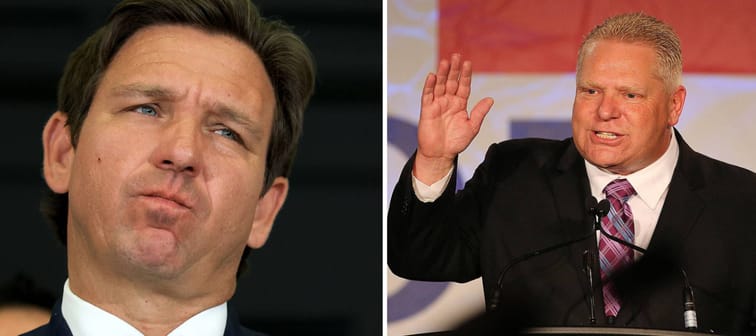
Florida Governor Ron DeSantis took aim (1) at Ontario Premier Doug Ford this week after Ford said (2) he would not travel to Florida this year and encouraged Canadians to “stay here and support local tourism.”
DeSantis responded by highlighting Florida’s record-breaking tourism numbers and even tossed in a Stanley Cup reference, noting the state hosted 34.4 million visitors in the second quarter alone. “Actually we continue to break tourism records (and win Stanley Cups),” he wrote (3).
But beyond the political sparring, Ford’s comments tapped into something deeper — and more personal — for many Canadians, especially snowbirds who are quietly reassessing long-standing winter travel plans.
When a political message reflects snowbirds’ economic reality
For many Canadian snowbirds, the decision to stay home longer this winter isn’t ideological — it’s financial.
A weaker loonie, higher travel insurance premiums, rising medical costs abroad and ongoing uncertainty around U.S. policy have all changed the math. What sounds like a political statement increasingly mirrors what snowbirds are already doing: shortening stays, delaying departures or choosing Canadian destinations instead.
In that sense, Ford’s message didn’t spark a movement — it reflected one already underway.

Sponsored
Smart investing starts here
Build your own investment portfolio with CIBC Investor’s Edge online and mobile trading platform. Enjoy low commissions on trades and special pricing for active traders, students and young investors.
Get started todayStay strong, snowbirds — Florida feels it when you stay home
Still, there's something to be said about the almost-year-long movement to support Canada after President Donald Trump made his initial statement about Canada becoming the USA's 51st state.
Canadian snowbirds aren’t just winter residents — they are a major economic force in Florida. According to Visit Florida data (4), Canadian visitors to Florida fell by about 20% year over year in the second quarter, following a 16.9% decline in the first quarter. In raw numbers, Florida welcomed roughly 640,000 Canadian visitors in the second quarter — a sharp drop from the same period last year.
The financial impact of fewer snowbirds to the Sunshine State is significant. Some estimates suggest that reduced Canadian travel could cost South Florida alone up to US$90 million in lost revenue, affecting hotels, restaurants, rental properties and service jobs that rely heavily on long-stay snowbirds (4).
Across the U.S., the effect is even larger. Canadian travel to the United States overall is down just over 25%, according to Tourism Economics (5), contributing to a projected C$5.7 billion decline in international visitor spending this year. The U.S. Travel Association has identified fewer Canadian visits as the primary driver of that drop (6).
In other words: When snowbirds adjust their plans, it shows up on balance sheets.
Snowbirds are responding to cost, not conflict
This pullback isn’t driven by hostility toward the U.S. — although a portion can certainly be attributed to a reaction to the hostility Canada has felt from America's President. This pullback is also driven by practical realities facing snowbirds (and all Canadian travellers):
- A weaker Canadian dollar stretching fixed incomes
- Rising U.S. travel insurance and health-care costs
- Higher prices both at home and abroad
- A desire for flexibility in uncertain times
Staying strong doesn’t mean giving up winter travel altogether. It means adapting — sometimes year by year.

Sponsored
Take control of your money with Monarch
Simplify your finances with Monarch, the all-in-one app designed to help you budget, track spending, and hit your goals faster. For a limited time, get 50% off your first year with code WISE50.
Start your free trial todayCanada is capturing those dollars instead
While fewer Canadians are heading south, they’re still travelling. In the same quarter Florida highlighted record tourism, Canadians spent C$20 billion travelling within Canada, compared with C$8.1 billion abroad, according to Statistics Canada — a 28.4% increase in foreign travel spending, but still heavily weighted toward domestic trips (6).
That domestic spending supports Canadian jobs, small businesses and tourism-dependent communities — especially during the winter months when many regions need it most.
Not a boycott — a recalibration
Ford was clear that Canadians remain free to travel where they choose and that Canadians “love our American friends.” His comments weren’t a call for confrontation — they were a recognition that economic choices matter (8).
For snowbirds weighing sun against savings, tradition against flexibility, the message isn’t guilt — it’s validation.
The overall theme: Stay strong, snowbirds. Adjusting your plans isn’t turning your back on anyone. It’s responding to economic reality — and reinforcing Canada’s economic resilience at the same time.
— with files from Mike Crisolago
Article sources
We rely only on vetted sources and credible third-party reporting. For details, see our editorial ethics and guidelines.
The Toronto Sun (1); National Post (2); X (3); Visit Florida (4);
Florida Commerce (4); Travel and Tour World (6); CBS News (7); Tourism Economics (8); U.S. Congress Joint Economic Committee Minority (9); U.S. Travel Association (10); Statistics Canada (11)
How Dave Ramsey’s plan helps people ditch debt for good
Tired of living paycheck to paycheck? Dave Ramsey’s popular 7-step method shows you exactly how to wipe out debt and finally build real savings. No gimmicks — just a clear plan that works.

Melanie Huddart
Freelance contributor
Melanie is an editor and fact checker who is passionate about proofreading and editing personal finance content. She specializes in breaking down complex topics into easily digestible details to help people make wise financial decisions. Melanie holds a BA in honours English and a BEd from York University in Toronto, and has provided writing and learning support in high school and college classrooms. When she’s not polishing up content, you can find her on her yoga mat, road-tripping with her son and their yellow lab, or exploring the world’s next best beach.
Explore the latest articles

How to put Dave Ramsey’s 7 Baby Steps into action
"It's not a fairy tale,” explains Dave Ramsey about the results of his 7-step plan “Anyone can do it, and the plan works every single time."

Phil Osagie
Staff Writer


Disclaimer
The content provided on Money.ca is information to help users become financially literate. It is neither tax nor legal advice, is not intended to be relied upon as a forecast, research or investment advice, and is not a recommendation, offer or solicitation to buy or sell any securities or to adopt any investment strategy. Tax, investment and all other decisions should be made, as appropriate, only with guidance from a qualified professional. We make no representation or warranty of any kind, either express or implied, with respect to the data provided, the timeliness thereof, the results to be obtained by the use thereof or any other matter. Advertisers are not responsible for the content of this site, including any editorials or reviews that may appear on this site. For complete and current information on any advertiser product, please visit their website.
†Terms and Conditions apply.
