

Leslie Kennedy
Updated Dec 9, 2025
A 355-year-old document has become the centre of a high-stakes auction that brought together two of Canada’s wealthiest families and raised questions that reach far beyond corporate insolvency. The royal charter that created Hudson’s Bay Company (HBC) in 1670, long considered one of the most significant documents tied to Canada’s early colonial foundations, is now poised to enter public hands after an unusual and closely watched bidding process.
The outcome matters not only for historians. For Canadians thinking about legacy planning, charitable giving or long-term stewardship of assets, the saga offers an unexpected window into how money, influence and public interest can align.
When corporate collapse pushes history into the marketplace
HBC sought creditor protection earlier this year and began selling assets to help repay more than $1 billion it owed. Its leases and thousands of artifacts were listed for sale, including the charter signed by King Charles II that granted HBC exclusive fur-trading rights and control over a vast territory that covered much of what is now Canada.
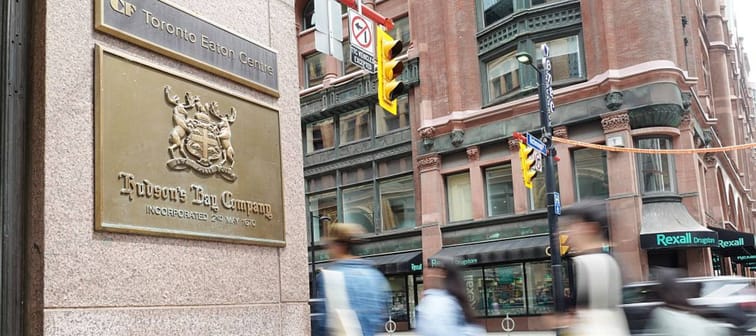
The company’s plan included auctioning the charter, once held in its Toronto head office. As court filings made clear, buyers were required to donate the document to a Canadian public institution, ensuring it would not disappear into private hands.
The auction path did not unfold in a straight line. An early private offer from the Weston family through Wittington Investments Ltd. proposed $12.5 million along with $1 million for conservation (1). A competing signal from the Thomson family, through DKRT Family Corp., argued the charter should go to auction instead (2).

Sponsored
Smart investing starts here
Build your own investment portfolio with CIBC Investor’s Edge online and mobile trading platform. Enjoy low commissions on trades and special pricing for active traders, students and young investors.
Get started todayHow two powerful families rewrote the bidding story
The two families, whose business interests span media, technology and retail, initially appeared to be on a collision course. But court documents later revealed they opted to unite behind a joint offer (3). Their combined $18 million bid became the official starting point after the court approved the process.
By the deadline for competing bids, none had come forward. That left the Thomson-Weston consortium as the uncontested buyer when the auction took place on Dec. 3 (4). Both families have said they intend to donate the charter immediately and permanently to four Canadian institutions: the Archives of Manitoba, the Manitoba Museum, the Canadian Museum of History and the Royal Ontario Museum.
Their donation includes $5 million earmarked for conservation, programming and public tours. Other philanthropists, including the Desmarais family and the Hennick Family Foundation, have signalled additional support.
An auction with one outcome but many implications
Although the families emerged as the only bidders, court approval is still required before the sale can close. Once finalized, the charter will circulate among the four institutions. The families have expressed a preference for it to be shown first in Winnipeg, reflecting HBC’s historic headquarters shift from London to Manitoba before being moved to Toronto at a later date.
Cultural institutions have said they expect to develop a long-term plan for display, preservation and educational access, including consultation with historians and Indigenous communities.

Sponsored
Take control of your money with Monarch
Simplify your finances with Monarch, the all-in-one app designed to help you budget, track spending, and hit your goals faster. For a limited time, get 50% off your first year with code WISE50.
Start your free trial todayWhat the charter’s journey says about legacy and money
The charter’s journey underlines several principles that apply far beyond elite philanthropy.
Not all returns are financial. Families, trusts and foundations sometimes choose to allocate capital to cultural or historical assets that provide public value rather than measurable investment gains.
Pooling resources can extend impact. By combining their bids, the families ensured the document would remain accessible. Shared ownership or cooperative funding models can make large philanthropic or legacy projects possible for families who would not take them on alone.
Long-term stewardship matters. The $5 million conservation commitment signals a multi-decade vision. For individuals thinking about estate planning or charitable bequests, funding ongoing care can matter as much as the initial gift.
Public benefit is its own asset class. The charter will be accessible to Canadians instead of held privately. For donors, placing valuable assets in public trust can build a legacy that outlives traditional financial metrics.
The next chapter in public stewardship
With court approval still pending, the charter’s formal transfer has not yet occurred. But the institutions preparing to receive it have already begun planning for how it will be shared. The Manitoba Museum has said its goal is to “ensure broad public access and understanding” of the charter’s role in shaping Canada’s early economic, political and social history, and to explore its complex legacy within the fur trade and colonization (5).
Turning history into legacy: Lessons from the Hudson’s Bay charter
This 355-year-old document helped shape Canada’s early economy, politics and Indigenous relations. Its preservation reminds us that wealth is not only a tool for accumulation — it can safeguard stories, protect shared heritage and strengthen institutions that define a nation.
For Canadians thinking about their own legacies, it underscores the power of values-guided decisions, long-term planning and giving that extends meaningfully beyond a single act. In the end, money, when paired with vision and care, can help ensure that history and impact endure for generations.
Article sources
We rely only on vetted sources and credible third-party reporting. For details, see our editorial ethics and guidelines.
Alvarez & Marsal (1, 2, 3); CityNews (4); Manitoba Museum (5)
How Dave Ramsey’s plan helps people ditch debt for good
Tired of living paycheck to paycheck? Dave Ramsey’s popular 7-step method shows you exactly how to wipe out debt and finally build real savings. No gimmicks — just a clear plan that works.

Leslie Kennedy
Senior Content Editor
Leslie Kennedy served as an editor at Thomson Reuters and for Star Media Group, followed by a number of years as a writer and editor and content manager in marketing communications, before returning to her editorial roots. She is a graduate of Humber College’s post-graduate journalism program and has been a professional writer and editor ever since.
Explore the latest articles

Is it time to swap your travel rewards credit card for cash-back?
With your travel plans up in the air, it may be time for a new credit card.

Barry Choi
Contributor


Disclaimer
The content provided on Money.ca is information to help users become financially literate. It is neither tax nor legal advice, is not intended to be relied upon as a forecast, research or investment advice, and is not a recommendation, offer or solicitation to buy or sell any securities or to adopt any investment strategy. Tax, investment and all other decisions should be made, as appropriate, only with guidance from a qualified professional. We make no representation or warranty of any kind, either express or implied, with respect to the data provided, the timeliness thereof, the results to be obtained by the use thereof or any other matter. Advertisers are not responsible for the content of this site, including any editorials or reviews that may appear on this site. For complete and current information on any advertiser product, please visit their website.
†Terms and Conditions apply.
