
While we adhere to strict editorial guidelines, partners on this page may provide us earnings.

Monique Danao
Updated Dec 24, 2025
A long-dormant copper mine in Beaver County, Utah, resumed operations earlier this year under new ownership — and Canadian investors need to pay attention.
At the mid-point of 2025 and copper's global demand, as a commodity, is soaring. From green energy to electric vehicles to consumer electronics, copper is one of the components helping to power what some experts are calling the next industrial revolution. As prices for copper hit record highs and supply shortages loom the copper reserves across North America — and the companies mining them — could see a surge in value.
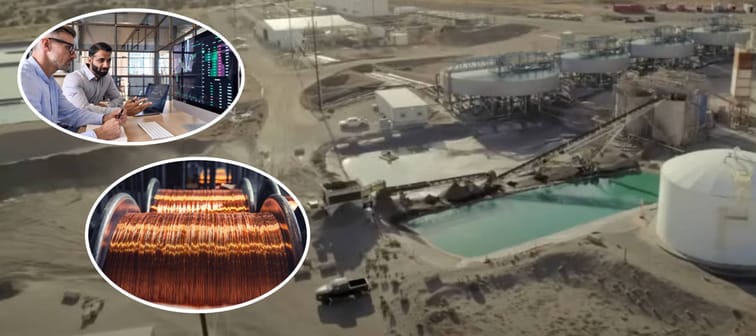
One sign of this resource resurgance is the reawakening of a long-dormant copper mine in Utah. Closed in 2019, the mine just roared back to life under new ownership — reflecting the rising global appetite for this critical mineral.
Here's why Canadian investors need to pay attention.
Why demand for copper is surging
According to the International Energy Agency (IEA), global copper demand is expected to accelerate sharply as countries expand electricity networks and electrification efforts. Under current project pipelines, the IEA estimates a significant supply gap could emerge by the mid-2030s unless investment in new mines accelerates — with shortfalls ranging from roughly 20% to more than 30% depending on policy outcomes (1). In other words, demand is expected to far outpace supply.
Then there are global factors. In July, the price of copper reached record highs after current American President Donald Trump announced a 50% tariff on copper imports beginning August 1, 2025. Given that copper is the “metal of electrification” and whether it’s used for wire, plumbing, electronics or electric cars, copper is critical in almost all products. The introduction of the copper tariff will only help to increase the cost of the metal and add to the cost of clean energy, communication, data centre infrastructure, to name a few.
Copper prices have remained elevated and volatile through 2024 and into 2025, driven by tight global supply, rising electrification demand and renewed infrastructure spending. While prices surged at several points, they remain below inflation-adjusted record highs set in 2022, underscoring copper’s cyclical — and often unpredictable — nature.
Re-opening the Utah mine is just the start
Closed in 2019, the Utah copper mine was a victim of a commodity slump that prompted low copper prices. But in 2023, Milford Mining acquired it and began hiring workers, according to a recent Fox 13 report (2). This year, the company struck a deal to sell its copper to Rio Tinto Kennecott, the operator of the Bingham Canyon mine and the Magna smelter. The contract is a strong signal that the price of copper isn't expected to drop anytime soon.
As this small mining town in Utah grows and prospers from copper's resurgance, it's a good reminder that additional mines across North America could also prosper from this metal's valuation growth. Investors looking for opportunities don't need to look far with a number of copper mines already in operation in Canada and managed by publicly-traded firms, including:
| Mine | Location | Public Operator | Notes |
|---|---|---|---|
| Highland Valley | near Logan Lake, British Columbia | Teck Resources Limited (TSX: TECK.A) | Canada’s largest copper operation; life extended through 2046 |
| Gibraltar Mine | near McLeese Lake, British Columbia | Taseko Mines (TSX: TKO.TO) | -- |
| Copper Mountain Mine | near Princeton, British Columbia | Hudbay Minerals (TSX: HBM.TO) | -- |
| Mount Milligan Mine | northern British Columbia, between Fort St. James and Mackenzie | Centerra Gold (NYSE: CGAU) | -- |
| Kidd Creek Mine | near Timmins, Ontario | Glencore (OTC: GLNCY) | -- |
| Red Chris Mine | Iskut area, British Columbia (Golden Triangle) | Newmont Corporation / Imperial Metals (TSX: NGT.TO) | 70% owned and operated by Newmont Corporation (public via acquisition of Newcrest), with 30% held by Imperial Metals (public) |
NOTE: These are among the major copper producers; Canada has other smaller or junior‑company‑operated copper operations, but those are often private or pre‑production. All of the listed mines are actively producing copper as of mid‑2025; however, the Mount Polley Mine is both copper andgold but currently in care and maintenance mode. It was reopened in 2022 but with uncertain operations and is still considered not actively in production.
Given Canada's role as a natural resource mecca, and its robust supply of copper, this could be the ideal time for an investor to consider precious metals, including copper.

Sponsored
Smart investing starts here
Build your own investment portfolio with CIBC Investor’s Edge online and mobile trading platform. Enjoy low commissions on trades and special pricing for active traders, students and young investors.
Get started todayWhy Canadian investors could benefit from the copper resurgence
With resource-rich Canada positioned as a major global copper producer, the resurgence in demand for the metal presents a significant opportunity for our economy — particularly as we transition to green energy.
In an S&P Global report (3), it was found that in order to achieve the goal of Net-Zero Emissions by 2050, green energy sectors will increase their demand for resources, including copper resulting in an 82% increase in demand for this precious metal between 2021 and 2035.
In fact, the demand for copper for the next decade will be primarily as a result of the ongoing push to transition to cleaner vehicles and the broader electrification of the economy. Electric vehicles alone use up to four times more copper than vehicles with internal‑combustion engines. Similarly, wind turbines, solar farms and data centres require extensive wiring and cabling.
Like Utah, the increased demand for copper has far reaching impact, on regional development as well as on investor portfolios.
For Canadians investors there's good news: Canada is a meaningful — but not dominant — global copper producer. According to Natural Resources Canada, the country holds roughly 2% of known global copper reserves, placing it among the world’s top producers but well behind Chile and Peru. Canada’s strength lies in its political stability, infrastructure and ability to scale responsibly (4)
To grow, mining operations must attract investors — these invested funds are then used to increase critical mineral production (5). At this point, however, most publicly traded mining operations are producing enough of this resources to meet domestic demand. Global copper demand is expected to grow steadily through 2040 (6), driven largely by electric vehicles, grid expansion and renewable energy infrastructure. S&P Global estimates copper demand tied to the energy transition alone could double by the mid-2030s, requiring trillions of dollars in cumulative investment across mining and processing — far exceeding current production capacity (with estimates that demand will grow to US$12 billion by 2040).
To meet export demands, Canadian mining operations will need to strategically invest and grow even more.
How Canadian investors can capitalize on copper's resurgance
Here’s are three strategies to help Canadian investors benefit from the revived demand for copper:
#1. Direct investment in mining companies
Investing in companies that produce or explore for copper is the most direct strategy investors can use to generate earnings on copper's valuation growth. for investors to benefit. The Toronto Stock Exchange (TSX) and the TSX Venture Exchange (TSXV) are home to a wide range of these companies (7), including (but not limited to):
- Teck Resources Limited (TSX: TECK.A)
- Taseko Mines (TSX: TKO.TO)
- Hudbay Minerals (TSX: HBM.TO)
- Newmont Corporation (TSX: NGT.TO)
To get started, you'll need to open a direct investing brokerage account. Good options include:
- CIBC Investor's Edge: Build your own investment portfolio with the Investor's Edge online and mobile trading platform and enjoy low commissions.
- Wealthsimple: Trade stocks and ETFs commission-free, plus get a $25 cash bonus when you open your first Wealthsimple account (through this link) and fund at least $1 within 30 days. Terms and conditions apply. Visit Wealthsimple for up-to-date terms and conditions.
- Questrade: $0 trading fees, plus trade fractional shares on select equities. New accountholders get $50 cash back when you open a self-directed account with $250.
#2. Favourable exchange rate on the dollar
A Canadian investor can benefit from trading U.S.-listed stocks or equities that trade in USD by strategically taking advantage of exchange rate fluctuations between the Canadian dollar and the U.S. dollar (USD). Here's how:
** When CAD is strong relative to USD (in other words C$1 = US$0.80 or more), it gives Canadians more purchasing power in U.S. markets**
The benefits of this include:
- Ability to buy U.S. stocks “on sale” as you can convert CAD into USD at a more favourable rate, meaning each Canadian dollar buys more U.S. dollars. For example, C$10,000 might convert to US$8,000 instead of US$7,200 (when the Canadian dollar is weaker).
- Opportunity to buy more shares: You can buy more of high-quality U.S. stocks at a lower relative cost.
- Tax-efficient diversification: This is a good time to build or expand your exposure to the U.S. market, potentially improving global diversification without the drag of poor exchange rates.
#3. Canada’s position as a key supplier for the new “green” economy
Copper is a critical mineral for the global push toward a green economy and positions Canada as a key supplier. Aside from investing in mining operations, investors can focus on:
- Global ETFs with a focus on copper: For example, Global Copper Miners ETF (COPX) offers broader exposure and trades in USD.
- Battery metal ETFs: For example, Amplify Lithium & Battery Technology ETF (NYSE: BATT) or Global X Lithium & Battery Tech ETF (NYSE: LIT) offers broader green energy metals exposure and trades in USD.
Bottom line
While the re-opening of the Utah copper mine is a strong signal for a robust return of this precious metal, investors should remember that copper prices are cyclical and sensitive to global growth. Investors should buy during downturns or before major demand inflection points, such as new climate policy or the introduction of new infrastructure deals — growth that will only accelerate the demand for copper and help suppor the price growth for this precious metal.
— with files from Melanie Huddart, David Saric and Romana King
Article sources
We rely only on vetted sources and credible third-party reporting. For details, see our editorial ethics and guidelines.
Fox (1); IEA (2); S&P Global (3); Natural Resources Canada (4); Critical Path (5); S&P Global (6); Interactive Brokers (7)
How Dave Ramsey’s plan helps people ditch debt for good
Tired of living paycheck to paycheck? Dave Ramsey’s popular 7-step method shows you exactly how to wipe out debt and finally build real savings. No gimmicks — just a clear plan that works.

Monique Danao
Freelance journalist, editor and copywriter
Monique Danao is a highly-experienced journalist, editor and copywriter with an extensive background in finance and technology. Her work has been published in Forbes, Decential, 99Designs, Fast Capital 360, Social Media Today and the South China Morning Post. She leverages her industry expertise to produce well-researched and insightful articles. She has an MA in Design Research from York University and a BA in Communication Research from the University of the Philippines - Diliman.
Explore the latest articles

Best robo-advisors in Canada
Automated investing is so easy, the hardest part is choosing where to start.

Amy Legate-Wolfe
Freelance Contributor


Disclaimer
The content provided on Money.ca is information to help users become financially literate. It is neither tax nor legal advice, is not intended to be relied upon as a forecast, research or investment advice, and is not a recommendation, offer or solicitation to buy or sell any securities or to adopt any investment strategy. Tax, investment and all other decisions should be made, as appropriate, only with guidance from a qualified professional. We make no representation or warranty of any kind, either express or implied, with respect to the data provided, the timeliness thereof, the results to be obtained by the use thereof or any other matter. Advertisers are not responsible for the content of this site, including any editorials or reviews that may appear on this site. For complete and current information on any advertiser product, please visit their website.
†Terms and Conditions apply.
