

Emma Caplan-Fisher
Updated Jan 16, 2026
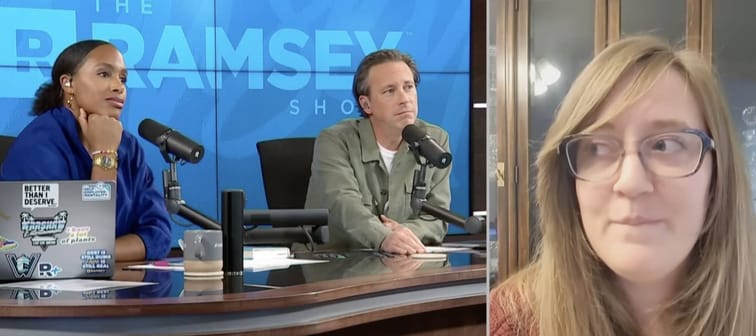
Breanne, a single mother, appeared live on video on The Ramsey Show and opened up about a spending addiction so serious that she’s currently in therapy to overcome it.
When cohosts Jade Warshaw and Ken Coleman asked what was driving her behaviour, she didn’t hesitate.
“It’s trauma,” she said, explaining that she’s undergoing Eye Movement Desensitization and Reprocessing (EMDR), a form of therapy designed to help people process past experiences.
Even while doing that deeper work, Breanne says she wants to change her spending habits right away. She knows the problem is affecting her finances — and her future.
But Breanne really wants to break her overspending habits now, even while she’s in therapy. She recognizes it’s a serious problem.
Each month, she estimates she spends up to half her US$4,800 (C$6,700) income on fast food, gifts for her daughter and impulse purchases. Over time, that pattern has contributed to roughly US$90,000 (C$125,000) in debt, including credit cards, personal loans and student loans.
Warshaw and Coleman praised Breanne’s honesty and courage in sharing her story so openly.
“You’re way tougher than a lot of people,” Coleman said. “I want you to harness that.”
The cohosts then guided Breanne through some practical steps to regain control of her spending — and challenged her to take one symbolic but meaningful action live on-camera to break the cycle (1).
Dealing with trauma and compulsive spending
The Ramsey Show cohosts were quick to acknowledge that money problems don’t always start with math — they often start with mental health.
There’s no precise statistics for compulsive buying in Canada, but Canadian health authorities recognize that problematic spending can be linked to stress, trauma and emotional coping behaviours (2).
Overspending that is driven by emotion or trauma doesn’t respond well to a budget alone. When spending becomes a way to cope with feelings rather than to meet basic needs, willpower and spreadsheets often fall short.
In those cases, therapy can play a crucial role. Cognitive Behaviour Therapy (CBT) is widely used in Canada to help people identify triggers, interrupt automatic responses and reduce compulsive urges over time. Addiction Resource Canada (ARC) outlines CBT as an effective, evidence-based approach for treating impulse-control and behavioural patterns linked to emotional distress (3).
Breanne is also using EMDR to work through trauma. EMDR is most commonly used for post-traumatic stress, and while it’s sometimes applied to compulsive behaviours, evidence is still emerging. The World Health Organization (WHO) recognizes EMDR as a trauma-focused therapy, but notes that treatment should be tailored to the individual and combined with practical support when needed (4).
That’s why Warshaw and Coleman suggested therapy alone might not be enough. They recommended pairing emotional work with clear behavioural safeguards.
One strategy they discussed was a form of “reverse psychology”: when the urge to spend hits, Breanne should pause and imagine how she’ll feel afterward — the regret, stress, guilt — instead of the brief rush that she experiences in the moment. Over time, that mental pause can weaken the automatic link between stress and spending.
Warshaw also pointed to habit design, citing author of Atomic Habits, James Clear, and his idea of making good behaviours automatic while adding friction to bad ones. For example, Breanne could set up automatic bill payments every paycheque so less money is immediately available for impulse purchases.
Finally, the hosts encouraged a symbolic step: Physically cutting up credit cards on-camera. Rituals like this can serve as a clear boundary — not only financially, but emotionally — marking a break from past patterns and creating accountability.
For people working through trauma, combining therapy with behavioural safeguards can be powerful. Therapy helps process the emotional roots of behaviour, while rules and rituals buy time for urges to pass. Breanne shared that she’d already cut up her credit cards, but still felt uneasy doing the same with her debit cards, a hesitation that reflects just how difficult real change can feel in practice.

Sponsored
Smart investing starts here
Build your own investment portfolio with CIBC Investor’s Edge online and mobile trading platform. Enjoy low commissions on trades and special pricing for active traders, students and young investors.
Get started todayWhat to do if you’re struggling — with or without therapy
If parts of Breanne’s story feel uncomfortably familiar, you’re not alone — and you’re not broken. Compulsive spending is often a response to stress, habit or emotion, not a lack of discipline. Here are some steps that can help, whether or not therapy is part of your journey right now:
Consider therapy. Ideally work with a therapist experienced in trauma or impulse control or money-related stress. Approaches like CBT, EMDR or other trauma-informed practices can help you understand triggers and build healthier responses over time.
Set up practical safeguards. Whether or not therapy is accessible to you, change usually needs practical guardrails. Start by making spending harder in the moment. Put credit cards out of reach, ask a trusted friend or family member to temporarily hold them or lower your limits where possible. Keep only one low-limit debit card for necessities.
Create friction around nonessential spending. Try using cash instead of credit or debit, setting a 24- or 48-hour waiting period before making purchases or doing a quick “pain check” by asking yourself how you’ll feel after the purchase, rather than just during it.
Use budgeting tools. Tracking matters — use a simple budgeting tool or banking app to record every dollar, review all transactions at the end of the month and look for patterns. Awareness alone can reduce impulsive behaviour.
Lean on accountability. Don’t try to do all this completely alone. Accountability helps — whether that’s a friend, partner, support group or financial coach. Having someone who knows what you’re working on can make it easier to pause, with a partner, regroup and choose differently when the urge to spend hits.
Compulsive spending is rarely only about money. As Breanne's story shows, it’s often tied to stress, habit and deeper emotional patterns.
If you’re struggling, start small: Add friction to spending, track your money honestly and lean on accountability supports. And if spending feels out of control, secretive or tied to emotional distress, it may be worth reaching out for professional help — not as failure, but rather as a step forward toward relief and stability.
—With files from Melanie Huddart
Article sources
We rely only on vetted sources and credible third-party reporting. For details, see our editorial ethics and guidelines.
The Ramsey Show (1); Government of Canada (2); Addiction Resource Canada (3); World Health Organization (4);
How Dave Ramsey’s plan helps people ditch debt for good
Tired of living paycheck to paycheck? Dave Ramsey’s popular 7-step method shows you exactly how to wipe out debt and finally build real savings. No gimmicks — just a clear plan that works.

Emma Caplan-Fisher
Freelance Contributor
Emma Caplan-Fisher has over a decade of experience writing and editing various content types and topics, including finance, business & tech, real estate & design, lifestyle, and health & wellness. Emma’s work has been featured in Real Estate Magazine, Cottage Life, Bob Vila, the Vancouver Real Estate Podcast, the Chicago Tribune, Narcity Media, Healthline, and other media outlets. She holds a Certificate in Editing from Simon Fraser University.
Explore the latest articles

Dave Ramsey: 4 tips to become a millionaire
Dave Ramsey offers simple advice on how to get rich — and for anyone looking to become a millionaire, these Ramsey solutions may be the key

Hannah Logan
Money.ca writer


Disclaimer
The content provided on Money.ca is information to help users become financially literate. It is neither tax nor legal advice, is not intended to be relied upon as a forecast, research or investment advice, and is not a recommendation, offer or solicitation to buy or sell any securities or to adopt any investment strategy. Tax, investment and all other decisions should be made, as appropriate, only with guidance from a qualified professional. We make no representation or warranty of any kind, either express or implied, with respect to the data provided, the timeliness thereof, the results to be obtained by the use thereof or any other matter. Advertisers are not responsible for the content of this site, including any editorials or reviews that may appear on this site. For complete and current information on any advertiser product, please visit their website.
†Terms and Conditions apply.
