

Monique Danao
Updated Dec 4, 2025
When Nobel Prize-winning economist Paul Krugman was asked whether voters should believe politicians who promise to “bring prices down,” his answer was blunt.
“Any politician who promises to bring prices way down is either ignorant or lying, or both,” he said in an interview on Hasan Minhaj’s podcast (1).
Krugman was speaking about U.S. politics — but his warning lands squarely in Canada, where affordability has become the country’s defining political issue and Mark Carney has staked much of his early agenda on easing cost-of-living pressure (2).
The message from Krugman is simple: Prices rarely go down — and usually shouldn’t — in a healthy economy. And no politician, no matter how persuasive, can force them.
Why Krugman’s warning applies to Canada
In the interview, Krugman explained a point that economists take for granted, but many voters understandably miss: Modern economies operate on steady, positive inflation, not deflation.
The Bank of Canada targets around 2% inflation (3) because low, predictable price growth keeps the economy stable.
Deflation, on the other hand, is catastrophic: When prices fall broadly, people delay purchases, businesses pull back investment and debts become harder to repay.

Sponsored
Smart investing starts here
Build your own investment portfolio with CIBC Investor’s Edge online and mobile trading platform. Enjoy low commissions on trades and special pricing for active traders, students and young investors.
Get started todayCarney’s affordability pledge meets economic reality
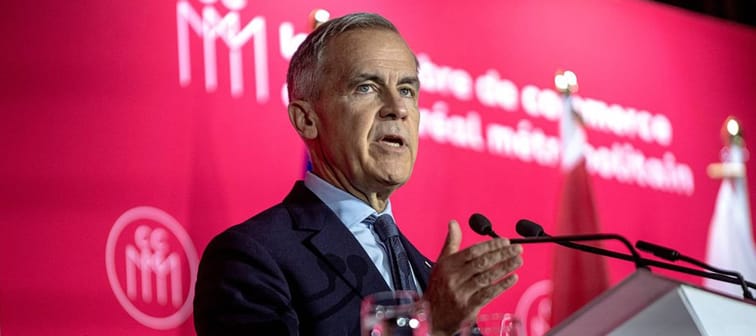
Mark Carney came into office with the aura of a technocratic problem-solver — a former Bank of Canada governor promising competence, stability and relief for households squeezed by years of high inflation and soaring housing costs.
His platform pledged to rebuild Canada (4) through targeted tax changes, cheaper child care, a major housing-construction push (5) and reforms to competition and internal trade.
But the structural forces driving Canadian prices aren’t easily reversed. Grocery prices have increased by 26% (6) since 2019. In Montreal, rents have surged by 70.8% (7) from pre-pandemic levels. Mortgage payments have climbed as households renew at higher rates. Utilities, insurance and transportation costs have also remained high.
Even as headline inflation receded into the 2–3% range, many Canadians feel little relief because rising prices (8) are affecting their ability to meet daily expenses.
Krugman’s point underscores the challenge Carney faces: Voters want prices to go back, not simply rise more slowly. But modern economic policy is designed to prevent that.
The Bank of Canada will fight inflation back to 2%, but it will not push prices back to 2020 levels. That means the “affordability crisis” is not about reversing prices, it’s about helping households cope with their new reality.
What Canadian households can do to stay afloat?
Since major political promises carry built-in limitations on price-cutting, here are practical steps Canadians can take:
Audit your spending
Go through one or two months of bank and credit-card statements. Identify subscriptions, fees and impulse-spend categories you may have accidentally missed and trim or downgrade them. A survey found that 73% of Canadians (9) admitted they had paid for subscriptions they had forgotten about.
Prioritize high-interest debt
Interest rates on Canadian credit cards are often between 19.99% and 25.99% (10). In a world where groceries cost more, and housing absorbs half a paycheque, expensive debt becomes a second inflation. Paying down these balances — or consolidating them into a lower-rate loan — offers the highest “return” on any spare dollar.
Build a small emergency buffer
The Government of Canada advises (11) that emergency funds help you handle unexpected expenses without going into debt. Even a modest emergency fund can keep a surprise bill from turning into new high-interest debt the next time a car or home repair emerges without warning.
Inflation-proof your long-term savings
For funds not needed in the near term, diversified investment accounts through RRSPs and TFSAs (12) can outpace inflation over the long term. The goal isn’t to beat grocery prices tomorrow, but to protect your future purchasing power.
Invest in earning power
Whether through training, certifications, shifting into higher-paying sectors or gaining in-demand skills, boosting income is one of the few strategies proven to outrun rising costs over a lifetime.

Sponsored
Take control of your money with Monarch
Simplify your finances with Monarch, the all-in-one app designed to help you budget, track spending, and hit your goals faster. For a limited time, get 50% off your first year with code WISE50.
Start your free trial todayBottom line
Krugman’s message is sobering: Inflation can be managed, but prices don’t go backward.
In an economy built around steady inflation, the most realistic path to affordability is to protect your income and plan for a world where prices continue inching up — even in the best of times.
Article sources
We rely only on vetted sources and credible third-party reporting. For details, see our editorial ethics and guidelines.
YouTube (1), Prime Minister of Canada (2), Bank of Canada (3), Lexology (4), CREA (5), RBC (6), Statistics Canada (7), Statistics Canada (8), Wealth Professional (9), Credit Canada (10), Government of Canada (11), Edward Jones (12)
How Dave Ramsey’s plan helps people ditch debt for good
Tired of living paycheck to paycheck? Dave Ramsey’s popular 7-step method shows you exactly how to wipe out debt and finally build real savings. No gimmicks — just a clear plan that works.

Monique Danao
Freelance journalist, editor and copywriter
Monique Danao is a highly-experienced journalist, editor and copywriter with an extensive background in finance and technology. Her work has been published in Forbes, Decential, 99Designs, Fast Capital 360, Social Media Today and the South China Morning Post. She leverages her industry expertise to produce well-researched and insightful articles. She has an MA in Design Research from York University and a BA in Communication Research from the University of the Philippines - Diliman.
Explore the latest articles

How to put Dave Ramsey’s 7 Baby Steps into action
"It's not a fairy tale,” explains Dave Ramsey about the results of his 7-step plan “Anyone can do it, and the plan works every single time."

Phil Osagie
Staff Writer


Disclaimer
The content provided on Money.ca is information to help users become financially literate. It is neither tax nor legal advice, is not intended to be relied upon as a forecast, research or investment advice, and is not a recommendation, offer or solicitation to buy or sell any securities or to adopt any investment strategy. Tax, investment and all other decisions should be made, as appropriate, only with guidance from a qualified professional. We make no representation or warranty of any kind, either express or implied, with respect to the data provided, the timeliness thereof, the results to be obtained by the use thereof or any other matter. Advertisers are not responsible for the content of this site, including any editorials or reviews that may appear on this site. For complete and current information on any advertiser product, please visit their website.
†Terms and Conditions apply.
