

Monique Danao
Updated Jan 13, 2026
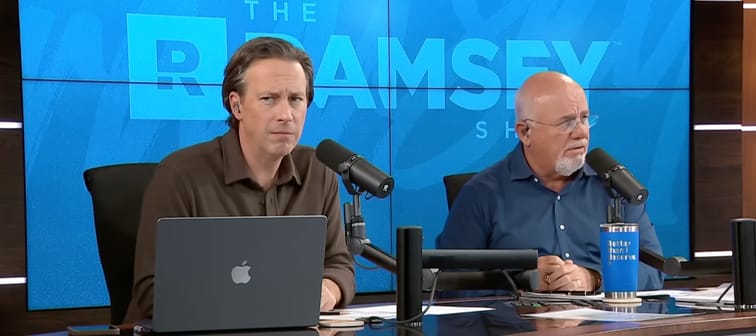
A man from Long Island, NY, called into The Ramsey Show and revealed that his family has fractured after some mischevious financial dealings came to light. After his father died, he convinced his 81-year-old widowed mother to place her US$96,000 inheritance into a certificate of deposit (CD) to keep it safe.
When he later checked the account balance, he discovered the funds were gone. His brother — listed as a joint owner — had withdrawn every cent from his mother’s CD.
After taking the money, the brother cut off all contact.
The caller and his mother are completely devastated. He asked Dave Ramsey (1) whether he should take the matter to court.
“I couldn’t care less if he’s pissed off,” Ramsey said. “I want to put him in front of an 18-wheeler.”
Ramsey stressed that, from a legal standpoint, the brother may have done nothing wrong.
His mother's money was in a joint account, and Canadian and U.S. banks operate similarly: any joint account holder (2) can withdraw the full balance at any time unless restricted by a formal agreement.
A family decision with unintended consequences
The caller explained that his mother had undergone surgery for a brain tumour and struggled with her health. After their father passed away, they suggested placing the inheritance into an auto-renewing CD for security.
To keep administrative matters simple, he added his brother’s name to the account — assuming all siblings would split the money equally later.
“We thought it'd be like an easy split, putting it on a CD. I didn't think of anything else,” he said.
The brothers fell out in October. Months after their conflict, the caller learned that his brother had withdrawn the inheritance in March 2024.
The bank confirmed that, because it is a joint account, either owner has full legal authority to remove all funds.
“You guys were so dumb. You put his name on it… I’m not sure it’s legally stealing because his name was on the account.” Ramsey said.
The financial guru noted that while the mother could hire a lawyer, it likely wouldn’t succeed. Similarly in Canada, if a family pursued a civil case, joint ownership usually supersedes verbal agreements or informal expectations.
If the perpetrator spent the money, a judgment likely won’t recover it.
“Courts don’t make people have money when they don’t have money,” Ramsey said. “You’re going to spend $10,000 chasing your mom’s money.”
The caller said his mother — who relies on disability assistance and government subsidies — does not want a long legal battle. Ramsey agreed that emotionally and practically, the best option may be to walk away.

Sponsored
Smart investing starts here
Build your own investment portfolio with CIBC Investor’s Edge online and mobile trading platform. Enjoy low commissions on trades and special pricing for active traders, students and young investors.
Get started todayWhy situations like this are more common than Canadians realize
Family-perpetrated financial exploitation is difficult to prove (3) because victims sign account forms without understanding the legal context.
According to the National Council on Aging, family members are involved in nearly 47% of incidents of elder abuse (4). Additionally, the Government of Canada notes how (5) elder-abuse networks are the most common form of financial abuse in the country.
Once an adult child is a joint account holder, they become the co-owner of the funds.
How Canadian families can avoid similar mistakes
Here are some ways Canadian families can avoid the same fate:
- Avoid joint family accounts: Joint accounts grant full ownership and withdrawal rights (6) to all account holders. Instead, ask your financial institution about “transfer on death” (TOD) (7) or “payable on death” mechanisms.
- Have formal estate-planning documents: Estate planning eliminates confusion and protects seniors from accidental and intentional financial harm. At minimum, families should establish a legally drafted will, a power of attorney for property, executor instructions and asset lists.
- Review accounts and documents: Families should review account ownership and beneficiary designations after significant events such as the death of a spouse, illness and changes in family dynamics.
In the end, the emotional fallout for this family may last far longer than the financial loss — and serve as a warning for families to protect aging parents with clarity, documentation and professional advice before any problems arise.
Article sources
We rely only on vetted sources and credible third-party reporting. For details, see our editorial ethics and guidelines.
The Ramsey Show (1); Government of Canada (2); BMO (3); National Council on Aging (4); Government of Canada (5); Nelligan Law (6); RBHF (7)
How Dave Ramsey’s plan helps people ditch debt for good
Tired of living paycheck to paycheck? Dave Ramsey’s popular 7-step method shows you exactly how to wipe out debt and finally build real savings. No gimmicks — just a clear plan that works.

Monique Danao
Freelance journalist, editor and copywriter
Monique Danao is a highly-experienced journalist, editor and copywriter with an extensive background in finance and technology. Her work has been published in Forbes, Decential, 99Designs, Fast Capital 360, Social Media Today and the South China Morning Post. She leverages her industry expertise to produce well-researched and insightful articles. She has an MA in Design Research from York University and a BA in Communication Research from the University of the Philippines - Diliman.
Explore the latest articles

Can you pay the CRA with a credit card?
Can you pay your taxes using a credit card? Yes, but that doesn’t mean you should. Here’s what to consider before swiping for the taxman

Leanne Armstrong
Contributor


Disclaimer
The content provided on Money.ca is information to help users become financially literate. It is neither tax nor legal advice, is not intended to be relied upon as a forecast, research or investment advice, and is not a recommendation, offer or solicitation to buy or sell any securities or to adopt any investment strategy. Tax, investment and all other decisions should be made, as appropriate, only with guidance from a qualified professional. We make no representation or warranty of any kind, either express or implied, with respect to the data provided, the timeliness thereof, the results to be obtained by the use thereof or any other matter. Advertisers are not responsible for the content of this site, including any editorials or reviews that may appear on this site. For complete and current information on any advertiser product, please visit their website.
†Terms and Conditions apply.
