

Christy Bieber
Updated Nov 28, 2025
Everyone loves free money, but sometimes where that money is coming from needs to be considered before accepting it.
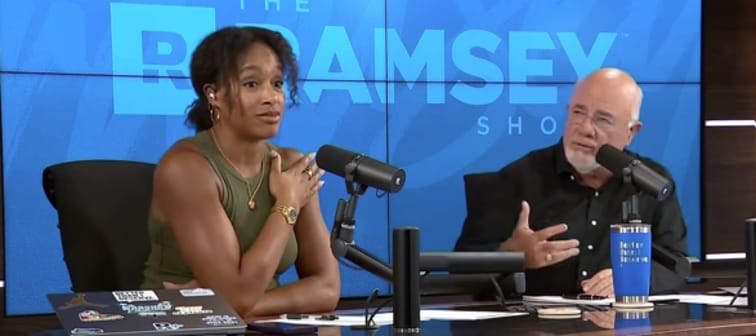
Take Garregg, for example, a Canadian man who called in to The Ramsey Show seeking advice on a unique situation (1). Garregg asked Ramsey what seemed like a simple question: “Should I accept my girlfriend’s extremely generous offer of paying off my debt for me?” He then explained to hosts Dave Ramsey and Jade Warshaw that he’s currently $35,000 in debt.
Ramsey didn’t waste too much time considering the answer — and he didn't leave much room for Garregg to share any additional details about the situation or his relationship with his girlfriend. Instead, Ramsey offered a blunt one-word reply: “No!”
Here’s why Ramsey was so against the idea.
“You’re going to have a problem”
After promptly condemning the idea of Garregg’s girlfriend paying off his debt, Ramsey revealed why he took such a strong stance.
“Do not pay debts for people you are not married to,” Ramsey said on the show. “Do not buy houses and cars for or with people you are not married to. Crap happens, and you’re going to get sideways and you’re going to have a problem.”
Ramsey highlighted multiple reasons why Garregg shouldn’t accept the offer, including the fact that doing so would change the dynamics of the relationship and could lead to big problems if the couple were to break up.
Ramsey also mentioned that Garregg’s financial obligation to his girlfriend could build resentment or may lead him to feel that he has to justify his financial decisions.
“You're going to change the tune of the relationship,” said Ramsey. “You're going to change the whole thing if she pays off your debt. What happens when you loan people money is, it changes the relationship.”
The hosts also pointed out that it doesn’t make a lot of sense for Garregg’s girlfriend to make this offer in the first place. As Garregg explained, he and his girlfriend are in a long-distance relationship — she lives in Switzerland — and she wants him to visit her more often.
Being debt-free would presumably make it easier for Garregg to be able to visit. But as Ramsey and Warshaw mentioned, the cost of a plane ticket is a lot less than Garregg’s $35,000 debt, so it might make more sense for his girlfriend to just pay for a few plane tickets.

Sponsored
Smart investing starts here
Build your own investment portfolio with CIBC Investor’s Edge online and mobile trading platform. Enjoy low commissions on trades and special pricing for active traders, students and young investors.
Get started todayWhy borrowing money before marriage is risky — for anyone
Ramsey’s advice also went beyond Garregg’s specific situation.
“You don’t pay off a dating relationship’s debt,” said Ramsey. “You do that when you’re married.”
Ramsey believes unmarried couples should keep their finances separate for a few reasons:
- Dating isn’t the same level of commitment as a marriage. Ramsey believes you shouldn’t pay off someone else’s debt until you are certain you’ll be building a shared life together.
- You don’t have the legal protections of marriage. If a married couple divorces, they can go to court to make sure assets are split fairly.
- You could derail your own financial security, especially after a breakup.
- You could change the nature of the relationship, leaving the paying person resentful and the recipient feeling indebted.
It’s possible to overcome some of these risks by taking some careful steps, like creating a written contract specifying whether the money is a gift or a loan. If Garregg and his girlfriend were to take this step and specify that the money is indeed a loan, they could also create a repayment schedule that addresses interest costs and frequency of payments.
However, there’s still a decent chance this won’t eliminate the potential for added conflict in their relationship.
What to consider before lending a significant other some money
If you’re considering paying down your partner’s debt or otherwise lending them money, you may want to discuss the following before doing so:
- How you would feel if your partner spent the money on “unnecessary” things when it was intended to pay off debt
- Whether you can trust your partner not to get back into debt again
- What would happen if you broke up, and whether you would expect them to repay the money
- What you would do if your partner were unable to pay you back
In the big picture, think about how loaning this large amount of money will affect your own financial goals. If it makes you unable to meet your own retirement savings goals or risk ending up in debt, you likely shouldn’t give the money to your partner.

Sponsored
Take control of your money with Monarch
Simplify your finances with Monarch, the all-in-one app designed to help you budget, track spending, and hit your goals faster. For a limited time, get 50% off your first year with code WISE50.
Start your free trial todayHow couples can discuss money without conflict
Scheduling a time to discuss financial issues can be helpful when addressing a stressful topic like money, as springing such a discussion on your partner at an unexpected time could potentially cause more stress.
When having these discussions about money, try to be open and nonjudgmental — and remember that you may need to have several money talks over time as your relationship evolves.
Having these kinds of discussions can hopefully help you and your partner with feeling more ready to merge your lives both romantically and financially. But until then, Ramsey’s advice is to keep your finances separate until you’re ready to make that commitment.
Article sources
We rely only on vetted sources and credible third-party reporting. For details, see our editorial ethics and guidelines.
The Ramsey Show (1)
How Dave Ramsey’s plan helps people ditch debt for good
Tired of living paycheck to paycheck? Dave Ramsey’s popular 7-step method shows you exactly how to wipe out debt and finally build real savings. No gimmicks — just a clear plan that works.

Christy Bieber
Freelance Writer
Christy Bieber a freelance contributor to Moneywise, who has been writing professionally since 2008. She writes about everything related to money management and has been published by NY Post, Fox Business, USA Today, Forbes Advisor, Credible, Credit Karma, and more.
Explore the latest articles

Costly financial pitfalls widows can face
Grief can cloud your judgment, and some decisions can have dire consequences in the future

Vawn Himmelsbach
Freelance Contributor

Disclaimer
The content provided on Money.ca is information to help users become financially literate. It is neither tax nor legal advice, is not intended to be relied upon as a forecast, research or investment advice, and is not a recommendation, offer or solicitation to buy or sell any securities or to adopt any investment strategy. Tax, investment and all other decisions should be made, as appropriate, only with guidance from a qualified professional. We make no representation or warranty of any kind, either express or implied, with respect to the data provided, the timeliness thereof, the results to be obtained by the use thereof or any other matter. Advertisers are not responsible for the content of this site, including any editorials or reviews that may appear on this site. For complete and current information on any advertiser product, please visit their website.
†Terms and Conditions apply.
