

Leslie Kennedy
Updated Nov 27, 2025
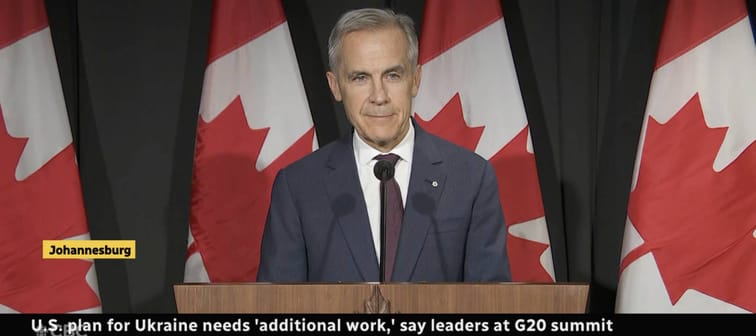
Prime Minister Mark Carney’s off-hand “Who cares?” was delivered with a shrug, but it travelled farther than the Johannesburg press scrum where he said it. Asked when he last spoke to Donald Trump about stalled tariff talks, Carney brushed it off. “Who cares? I mean, it’s a detail. I spoke to him. I’ll speak to him again when it matters.”
It was a clipped moment in a long trip overseas, yet it struck a nerve. In a year where tariffs have hit Canadian exporters and rattled cross-border relations, the idea of not caring felt almost rebellious. Some Canadians cheered the confidence. Others winced at the timing. And many asked a quieter question: Can average Canadians afford not to care?
A sound bite in a storm
The backdrop behind the quip is not simple. Canada and the United States remain each other’s most important trading partners. Statistics Canada reported in its latest merchandise trade update that about 73% of Canadian exports went south this summer (1). Even after months of tension, no other market comes close.
At the same time, trade talks collapsed last month after Trump lashed out over Ontario Premier Doug Ford’s anti-tariff ad that featured Ronald Reagan. Carney has spent the past several weeks abroad meeting G20 leaders, courting new investment and trying to bulk up trade ties with the Gulf and India. “We’ve had discussions. I’ve been busy,” he told reporters (2) when asked again about speaking to Trump. “He’s got other things to do and we’ll re-engage when it’s appropriate.”
Still, it is difficult for Canadians to casually wave off a souring relationship with a country that buys most of what we produce.

Sponsored
Smart investing starts here
Build your own investment portfolio with CIBC Investor’s Edge online and mobile trading platform. Enjoy low commissions on trades and special pricing for active traders, students and young investors.
Get started todayWhy some Canadians really do care
In certain pockets of the economy, tariffs are not an abstract political skirmish. An analysis from the RBC (3) found that three sectors are bearing the brunt: autos, steel and aluminium, and aerospace. Those categories made up more than 90% of tariff-hit exports. By July, shipments in those areas were down about 10% compared with last year.
If you work in a plant in Windsor or Oshawa, or in machining or metal fabrication in Winnipeg or Hamilton, these details matter. A slowdown can show up as fewer shifts for employees or hiring freezes. Families in trade-exposed regions feel the tension long before interest rates or GDP charts catch up.
And it is not only factory floors. Slower export demand can ripple into trucking, warehousing, engineering and small suppliers. Even a strong domestic consumer economy cannot always shield workers who sit near the first link of the supply chain.
Why many Canadians can afford to breathe
But the other half of the story is less dire. For most households, daily life has not been upended by the tariff fight. The broader consumer economy is still standing. Retail volumes have risen for several consecutive quarters, according to recent Statistics Canada data (4). Wages continue to grow faster than headline inflation in many regions.
For Canadians who do not work in export manufacturing and buy mostly domestic or fully international goods, the trade drama can feel distant. Grocery prices have been influenced more by climate effects and shipping costs than by U.S. border politics. Gas prices have been shaped by global oil markets rather than tariff volleys.
This helps explain why Carney’s aside resonated. It captured a real sentiment: That Canada’s economic life does not begin and end with Washington.

Sponsored
Take control of your money with Monarch
Simplify your finances with Monarch, the all-in-one app designed to help you budget, track spending, and hit your goals faster. For a limited time, get 50% off your first year with code WISE50.
Start your free trial todayWhat caring looks like for the average person
Even if you have never read a tariff schedule, there are practical ways this moment filters into your financial life without demanding you obsess over every headline.
Know your exposure. You do not need to track trade negotiations, just understand how your job or region is directly impacted by U.S. demand. If your employer exports heavily or supplies someone who does, stay aware of how conditions evolve.
Keep flexibility in your financial plan. Tariff uncertainty tends to slow business investment, which can affect wage growth or hiring. A modest emergency fund or a diversified mix of income sources can smooth bumps that have nothing to do with your own performance at work.
Watch for price shifts. If tariffs expand or the Canadian dollar weakens, imported goods could cost more. Knowing your normal prices helps you spot real changes rather than reacting to noise.
Diversify your investments. If you invest in Canadian stocks, pay attention to whether your portfolio leans toward sectors exposed to cross-border risk. A bit of global diversification can cushion swings.
So should Canadians care?
Not in a panicked way. Not in an every-notification-buzzing way. But yes, in the same practical way you care about any major force that can nudge jobs, prices or consumer confidence.
Carney’s “Who cares?” may have been a moment of impatience, not indifference. For many Canadians, it captured a shift toward a broader, less U.S.-centric economic outlook. For others, especially in export-focused regions, it underscored how much is still at stake.
The real answer sits somewhere in between. You do not need to care loudly. You just need to care wisely.
Article sources
We rely only on vetted sources and credible third-party reporting. For details, see our editorial ethics and guidelines.
Statistics Canada (1, 4); CBC News (2); RBC (3)
How Dave Ramsey’s plan helps people ditch debt for good
Tired of living paycheck to paycheck? Dave Ramsey’s popular 7-step method shows you exactly how to wipe out debt and finally build real savings. No gimmicks — just a clear plan that works.

Leslie Kennedy
Senior Content Editor
Leslie Kennedy served as an editor at Thomson Reuters and for Star Media Group, followed by a number of years as a writer and editor and content manager in marketing communications, before returning to her editorial roots. She is a graduate of Humber College’s post-graduate journalism program and has been a professional writer and editor ever since.
Explore the latest articles

Here's the net worth you need to join Canada's 1%
Here's what portfolio dreams are made of.

Chris MacDonald
Freelance Writer


Disclaimer
The content provided on Money.ca is information to help users become financially literate. It is neither tax nor legal advice, is not intended to be relied upon as a forecast, research or investment advice, and is not a recommendation, offer or solicitation to buy or sell any securities or to adopt any investment strategy. Tax, investment and all other decisions should be made, as appropriate, only with guidance from a qualified professional. We make no representation or warranty of any kind, either express or implied, with respect to the data provided, the timeliness thereof, the results to be obtained by the use thereof or any other matter. Advertisers are not responsible for the content of this site, including any editorials or reviews that may appear on this site. For complete and current information on any advertiser product, please visit their website.
†Terms and Conditions apply.
